

INSIGHTS
GSI Framework OR Traditional Expert "Pitch"?

Every sales team has a pitch deck. Fewer have a plan for what happens when the prospect stops nodding along and starts asking, “Okay, but why does this matter to me?”
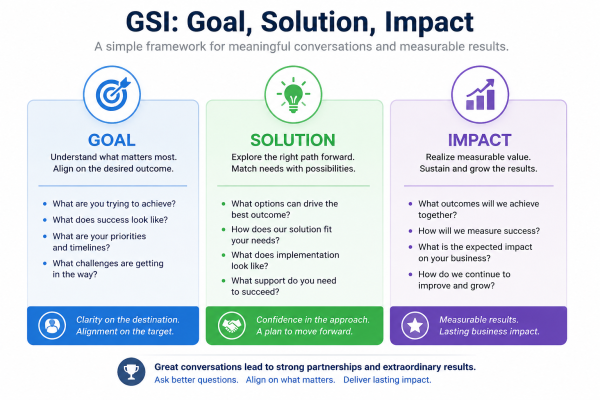
That’s the gap the GSI framework is built to close. GSI stands for Goal, Solution, Impact, and it’s quickly becoming one of the fastest-growing approaches in B2B sales this year. Not because it’s flashy. Because it forces reps to slow down and actually listen before they start selling.
What GSI Actually Means
Here’s the breakdown, in plain terms:
Goal. What is this prospect actually trying to accomplish? Not the surface-level answer they give in a discovery call, but the real business outcome sitting behind it. A VP of Ops doesn’t want “better software.” They want fewer escalations, faster onboarding, or a number they can bring to their own boss.
Solution. How does your product or service actually move that goal forward? This is where most reps default to a feature dump. GSI asks you to resist that urge and explicitly connect the dots rather than hoping the prospect does so on their own.
Impact. What does it look like in dollars, hours, or headcount once the goal is met? This is the part that gets skipped most often, and it’s the part that actually closes deals. Buyers aren’t just evaluating whether your product works. They’re building a case to justify the purchase to someone else, and that case needs a number attached.
Why This Framework Is Catching On Right Now
A few things are converging at once. Buyers are more skeptical of generic pitches than they’ve ever been. Sales cycles involve more stakeholders, which means your champion needs ammunition to sell the deal internally after your call ends. And budgets are tighter, so “this would be nice to have” doesn’t cut it anymore. Every purchase needs a business case.
GSI works because it hands reps a structure for building that case in real time, during the conversation, instead of scrambling to build it after the fact in a follow-up email nobody reads.
There’s also a quieter reason this is resonating. Reps are tired of frameworks that ask them to memorize twelve steps and a dozen objection scripts. GSI is three words. It’s simple enough to actually use on a call, which is more than you can say for most sales methodologies that get taught once in a training session and then forgotten by Friday.
How To Actually Use It
If you want to try this with your team, don’t overthink it. Build your discovery questions around uncovering the real goal first. Ask what happens if this problem doesn’t get solved. Ask who else is affected by it. Then, when you move into your pitch, don’t just explain what your product does. Explain how it gets the prospect from where they are to the goal they just told you about.
Save the impact conversation for last, and make it concrete. Not “you’ll save time.” Instead: “your team spends roughly six hours a week on this task, so if we cut that in half, that’s three hours back per rep, every week.” Numbers stick. Vague benefits don’t.
The Bigger Shift Behind It
GSI isn’t really a new idea. Good salespeople have been doing versions of this for decades. What’s different is that it’s being named, taught, and repeated as a framework right when buyers are demanding exactly this kind of clarity. That timing matters. A framework that fits how buyers already want to be sold to spreads faster than one that asks buyers to change their behavior.

QUESTION: In Conclusion
If your team is still leading with features and hoping the value speaks for itself, this is a good moment to rebuild the pitch around goals first. It’s a small shift in structure, but it changes the entire conversation. What do you think?
Until next time!
Kristin